Inventory
Every agent reports a full hardware/software inventory on each check-in — no manual scanning required.
What's collected
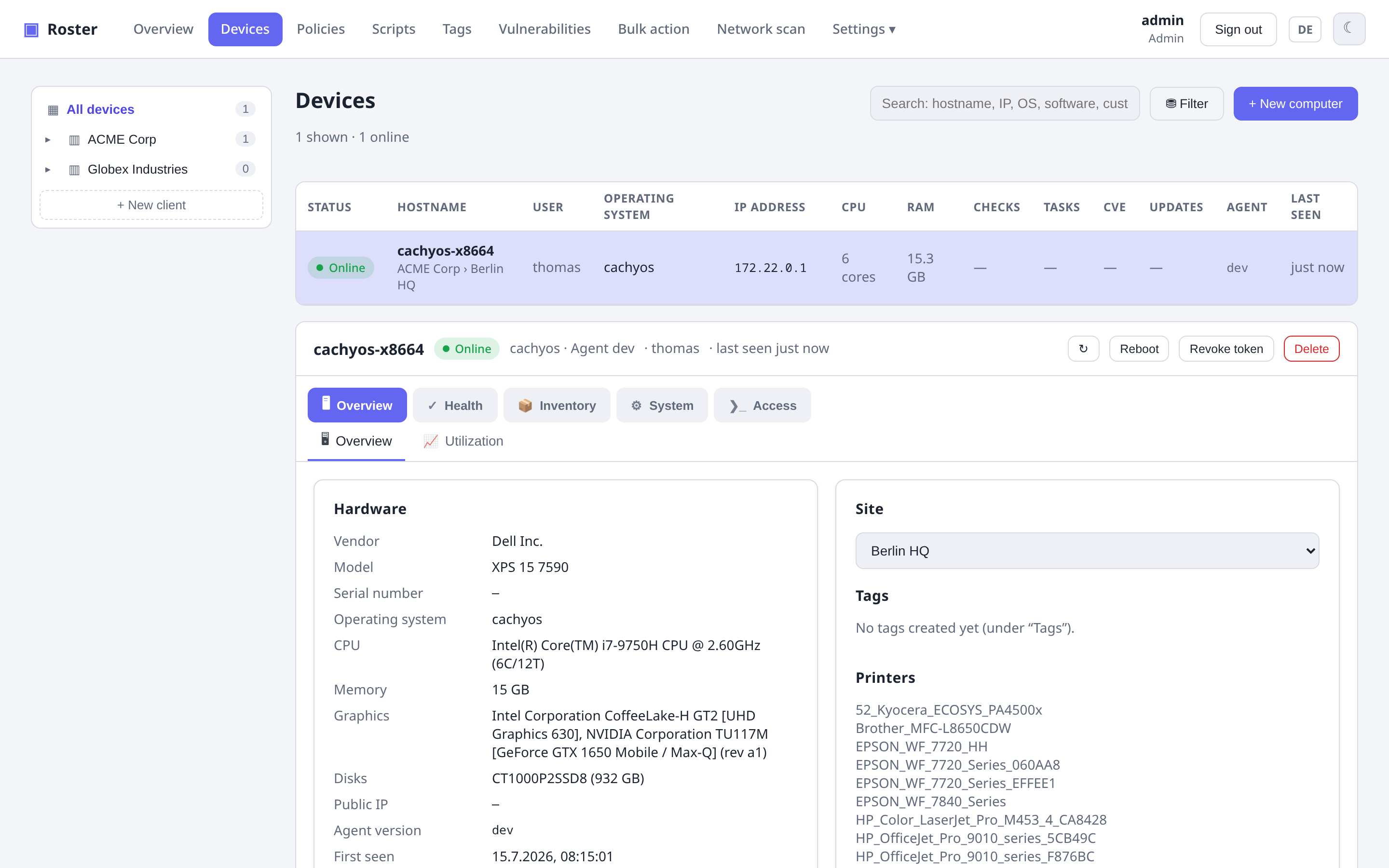
- Hardware: vendor, model, serial, CPU (model + cores), memory, disks.
- Operating system: name, version, logged-in users, uptime.
- Network: interfaces with IP and MAC addresses; public IP.
- Software: installed applications with versions; printers.
- Listening/open ports: the agent reports listening sockets (attack surface), with an external-reachability check and a ports-whitelist check type.
- Temperatures: every sensor the system exposes (CPU package/cores, chipset, NVMe,
GPU, board) with the chip's own warning and critical thresholds — shown on the device
overview with a status per sensor. Several SSDs are named after their kernel device
(
nvme0 Composite,nvme1 Composite) as in Proxmox; AMD CPUs, which report no limits, use AMD's Tjmax of 95 °C (warning from 85 °C). - Fans: speed (RPM), PWM duty and alarm flag of every fan on Linux (hwmon). Headers with nothing connected are left out; a fan that has spun before and stops is reported as stopped.
- Proxmox VE: on a PVE host, all VMs/containers with resources and backup state — see Proxmox VE.
Live utilization & history
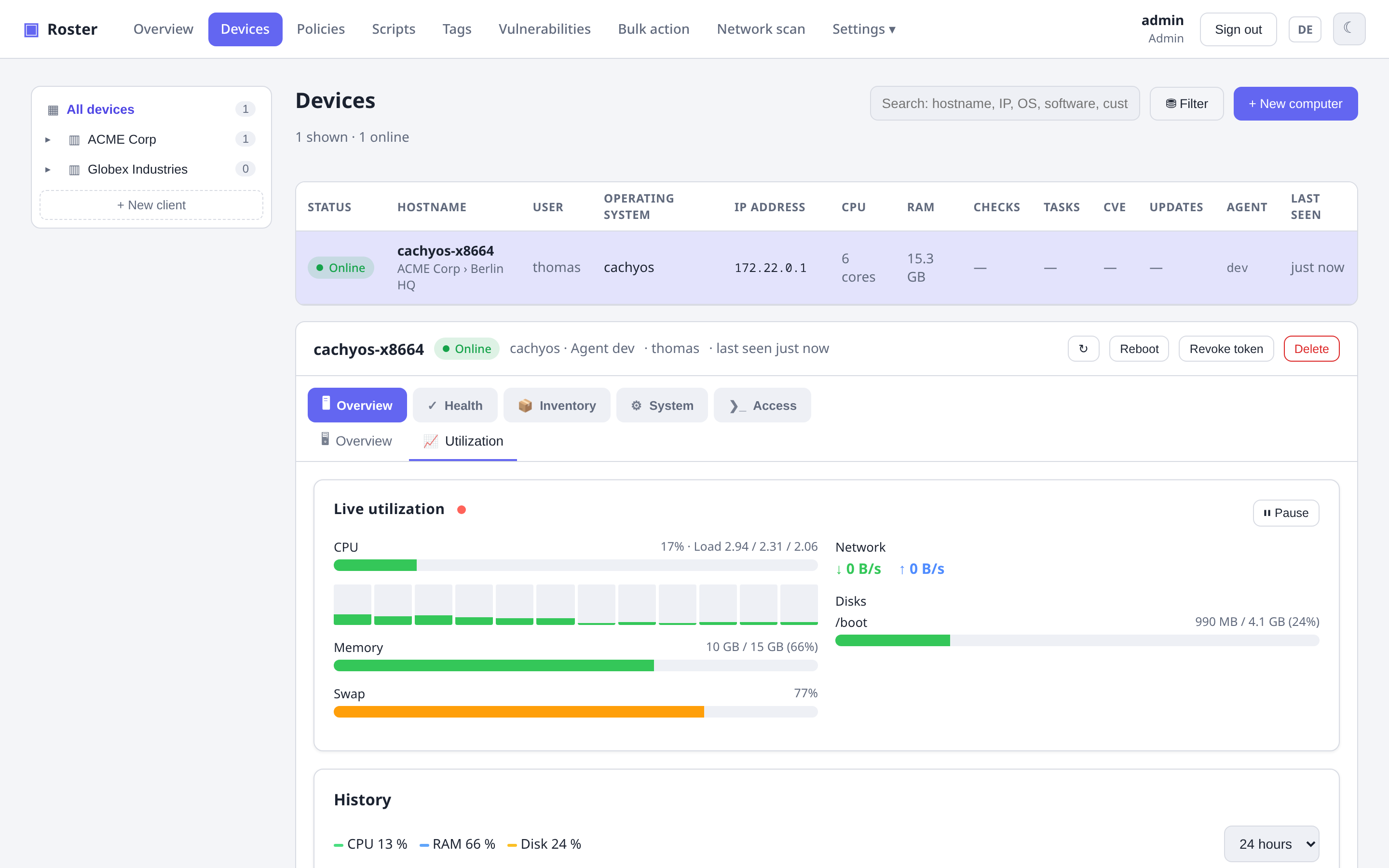
On demand, pull a live snapshot of CPU (per core), RAM, disk and network — and browse stored time series with 24 h / 7 d / 30 d charts. Devices with sensors get a second chart for the hottest CPU temperature (own °C axis, hover for value and time).
Where temperatures come from
Linux reads /sys/class/hwmon (including the thresholds of each chip), FreeBSD
sysctl, macOS the SMC and Windows the WMI thermal zones — which many Windows boards
leave empty. Virtual machines normally have no sensors at all; the section then simply
stays hidden.
Fans and board temperatures on Linux need the driver for the board's monitoring chip
(e.g. nct6775, it87) — CPU and NVMe sensors work out of the box, board chips often
only after modprobe nct6775 (or running sensors-detect once). Servers with a BMC
frequently expose fans only via IPMI. Many mini PCs have no OS-readable fan at all —
the embedded controller regulates it on its own; Roster then shows no fans.
Cross-platform agents
Agents run as a service on Windows, Linux and macOS and auto-update from the server. They use a pull model — only outbound connections, no inbound port on the client.
Custom fields
Attach TRMM-style custom fields to a company, site or device, and populate them with
JSON collector tasks and Twig-like placeholders (e.g. {{ agent.domains | first }}).